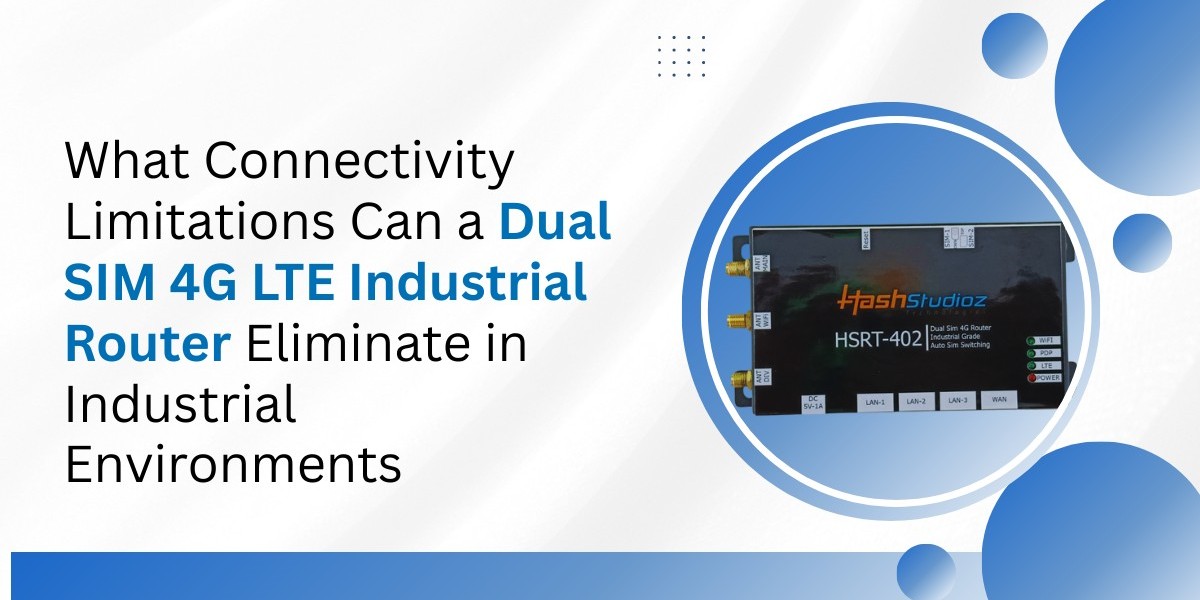
Industrial environments rely heavily on stable, continuous connectivity to ensure operational efficiency, safety, and productivity. Industrial processes often span wide areas, involve multiple devices, and operate in challenging conditions. Connectivity issues such as network downtime, signal loss, and limited redundancy can disrupt operations, cause financial losses, and compromise safety.
A Dual SIM Industrial Router, particularly a Dual SIM 4G LTE Industrial Router, addresses many of these connectivity limitations. By providing redundant network connections, high-speed communication, and remote management capabilities, these routers have become essential for modern industrial networks. This article examines the connectivity limitations that these routers can eliminate and explains their technical benefits in industrial applications.
Understanding Dual SIM Industrial Routers
A Dual SIM Industrial Router is a network device designed for industrial environments that supports two SIM cards simultaneously. It enables automatic failover between two cellular networks, ensuring continuous connectivity.
A Dual SIM 4G LTE Industrial Router specifically uses 4G LTE networks, providing high-speed, low-latency communication suitable for real-time monitoring and control applications.
Core Features
Dual SIM Redundancy: Automatically switches between two network providers if one fails.
High-Speed Data Transmission: 4G LTE connectivity ensures rapid data flow.
Industrial-Grade Design: Tolerates extreme temperatures, vibration, and moisture.
Remote Management: Allows configuration and monitoring of devices from a central location.
Security Protocols: Supports VPN, firewall, and encrypted data transmission.
Connectivity Limitations in Industrial Environments
Industrial environments face specific connectivity challenges due to their scale, complexity, and operating conditions. Understanding these limitations helps explain the importance of dual SIM routers.
1. Single Network Dependency
Many industrial sites use a single network provider for connectivity. This creates a risk of total network failure if the provider experiences an outage. Downtime caused by network issues can lead to:
Disruption of real-time monitoring
Loss of production control
Safety risks due to delayed alarms or alerts
2. Signal Loss in Remote Locations
Industrial sites are often located far from urban centers, such as:
Mining operations
Oil and gas installations
Renewable energy farms (solar and wind)
Single-network routers may experience weak signals or complete disconnection in these remote areas, reducing reliability and preventing timely data transmission.
3. Limited Bandwidth for Multiple Devices
Industrial networks often connect numerous devices, including sensors, PLCs, cameras, and automation systems. A single network may not provide sufficient bandwidth for high-data applications, such as video surveillance or real-time analytics.
4. Environmental Interference
Industrial environments generate electromagnetic interference (EMI) from heavy machinery, motors, and welding equipment. EMI can disrupt network communication, causing packet loss or connection drops.
5. Inflexible Network Scalability
As industrial operations expand, the need to add more devices or cover wider areas grows. Standard routers may not support flexible network topologies or failover configurations, limiting the ability to scale operations.
How a Dual SIM 4G LTE Industrial Router Eliminates Connectivity Limitations
A Dual SIM 4G LTE Industrial Router addresses the limitations above by providing redundancy, flexibility, and reliability for industrial networks.
1. Eliminating Single Network Dependency
Dual SIM routers support two cellular providers simultaneously. If one network fails due to congestion, maintenance, or signal loss, the router automatically switches to the second network.
Statistic: Research from MarketsandMarkets shows that network redundancy reduces industrial downtime by up to 50%, translating to millions in saved operational costs.
Example: A remote wind farm experiences a cellular network outage from Provider A. The dual SIM router switches to Provider B, ensuring continuous data transmission to the central SCADA system.
2. Maintaining Connectivity in Remote Locations
By connecting to two providers, dual SIM routers increase the likelihood of stable connectivity in areas with weak signals. Operators can select networks based on signal strength or coverage maps, reducing downtime.
Example: A mining operation in a mountainous region uses a Dual SIM 4G LTE Industrial Router. Even when one provider loses coverage, the router maintains connectivity using the second provider, enabling continuous monitoring of excavation equipment.
3. Providing Sufficient Bandwidth
Dual SIM routers can distribute data traffic across both networks, ensuring devices receive adequate bandwidth. This is crucial for:
Real-time video surveillance
High-frequency sensor data transmission
Remote control of industrial machinery
Example: A water treatment plant transmits high-resolution camera feeds for security. The dual SIM router divides the video streams across two networks, preventing network congestion.
4. Reducing Effects of Environmental Interference
Industrial-grade dual SIM routers are designed to withstand EMI, vibrations, and temperature extremes. Ethernet isolation, shielding, and advanced network protocols further protect communication.
Example: In a steel manufacturing facility, high-voltage machinery creates EMI. The dual SIM router maintains stable communication between sensors and the control room, preventing false alarms and operational errors.
5. Supporting Network Scalability
Dual SIM routers facilitate flexible network topologies. Operators can connect multiple devices and expand operations without redesigning the network.
Example: A solar farm adds new inverters and weather sensors. The dual SIM router supports additional devices without interrupting existing communications, making expansion seamless.
6. Enabling Remote Monitoring and Control
By using 4G LTE networks, dual SIM routers allow remote access to industrial sites, even in isolated areas. Engineers can monitor devices, update firmware, and troubleshoot issues remotely.
Example: An offshore oil rig uses a Dual SIM 4G LTE Industrial Router to send equipment status to a central monitoring center. Engineers adjust settings remotely, minimizing the need for on-site intervention.
Technical Advantages of Dual SIM 4G LTE Industrial Routers
Feature | Benefit | Example |
Dual SIM Redundancy | Continuous connectivity | Automatic failover during network outages |
High-Speed LTE | Low-latency data transmission | Real-time monitoring of PLCs and sensors |
Industrial-Grade Design | Reliable in harsh environments | Operation in -40°C to +75°C, with high vibration tolerance |
Traffic Load Balancing | Prevents bandwidth bottlenecks | Video surveillance and sensor data handled efficiently |
Remote Management | Reduces on-site visits | Firmware updates and monitoring from central office |
Security Features | Protects against cyber threats | VPN, firewall, and encrypted communication |
Real-World Applications
1. Energy Sector
Wind and Solar Farms: Continuous monitoring of turbines and inverters ensures energy output and operational safety.
Remote Substations: Dual SIM routers maintain SCADA connectivity, even during network outages.
2. Water and Wastewater Management
Pumping Stations: High-priority data from sensors and pumps reaches the central control room without delay.
Remote Reservoir Monitoring: LTE connectivity ensures water level and quality data is continuously transmitted.
3. Oil and Gas Operations
Offshore Platforms: Dual SIM routers provide failover between multiple providers, ensuring safety-critical data is always available.
Pipeline Monitoring: Real-time pressure and flow data are transmitted over LTE, preventing leaks or failures.
4. Industrial Automation
Factory Operations: Robots, PLCs, and sensors maintain connectivity even during network congestion.
Predictive Maintenance: High-frequency sensor data allows early detection of machinery wear, reducing downtime.
5. Transportation and Logistics
Remote Warehouses: Inventory tracking, security cameras, and IoT devices rely on dual SIM routers for uninterrupted connectivity.
Fleet Monitoring: Dual SIM LTE routers ensure vehicles remain connected, even when passing through areas with weak coverage from one provider.
Key Considerations When Choosing a Dual SIM Industrial Router
When selecting a dual SIM router for industrial environments, consider the following:
Carrier Compatibility: Ensure the router supports multiple LTE bands and providers in the operational area.
Environmental Tolerance: Verify operating temperature, humidity, and vibration resistance.
Data Throughput Needs: Choose routers that handle the expected number of devices and data traffic.
Security Features: VPN, firewalls, and encryption are essential for protecting industrial networks.
Remote Management Capabilities: Centralized monitoring and configuration reduce operational overhead.
Scalability: Ensure the router supports future expansion of devices and sensors.
Conclusion
Industrial environments face several connectivity limitations, including single network dependency, signal loss, bandwidth constraints, environmental interference, and limited scalability. A Dual SIM Industrial Router, particularly a Dual SIM 4G LTE Industrial Router, eliminates these limitations by providing:
Redundant network connections
Continuous connectivity in remote locations
Bandwidth optimization for multiple devices
Reliability under harsh environmental conditions
Remote monitoring and secure communication